Get the weekly radar
One short email with the freshest products, every week.

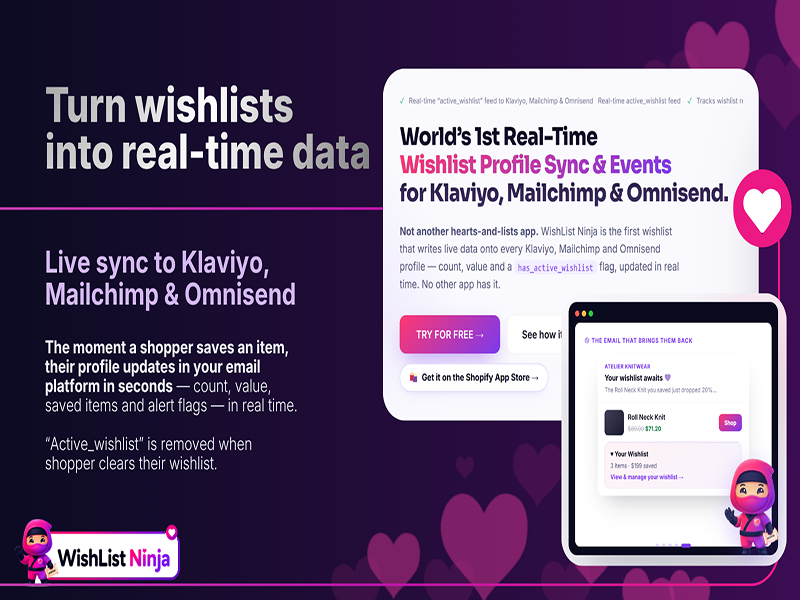
WishList Ninja writes live wishlist data onto every Klaviyo and Mailchimp profile.
Grounded in available product and source data
A typical wishlist heart icon just saves a product to a list sitting inside the store — WishList Ninja is a Shopify wishlist synced to your email platform instead, writing that same save directly onto the shopper's own Klaviyo, Mailchimp, or Omnisend profile.
That sync isn't a single fire-and-forget event either: live profile properties update in real time, including wishlist_count, wishlist_value, a has_active_wishlist flag, and flags for pending price drops or restocks, plus the top 10 saved products with image, name, price, and URL — all directly usable in a segment rule or a dynamic email block.
Seven named flow triggers turn that data into actual revenue moments: Added to Wishlist, Price Drop & Sale, Low Stock, Back in Stock, Saved a Collection, and New in Collection each fire straight into a connected email platform, with configurable thresholds for what counts as a meaningful price drop and low-stock alerts that adapt to high-volume versus limited-inventory items.
A repeat-revenue mechanic is named specifically to address a real gap in typical wishlist apps: once a shopper buys a saved item, it stays on their wishlist rather than disappearing, so a later price drop or restock on something else they saved can still win a second sale from the same customer. Because wishlists are account-backed, every save maps to a real, identified, emailable shopper profile rather than an anonymous browser session.
On technical footprint, the site states the storefront runs on a single script under 12KB served from Shopify's CDN, with no Liquid theme edits required and nothing left behind on uninstall. An analytics dashboard tracks wishlist-attributed revenue and a 'Most Wanted' report for what to restock, and migrating from another wishlist app preserves shoppers' existing saved items via CSV or Shopify metafields. The page reviewed does not specify a limit on the number of saved items per wishlist, worth checking directly for a store with an unusually large catalog.
It goes directly onto the shopper's email platform profile — live properties like wishlist_count and wishlist_value write onto Klaviyo, Mailchimp, or Omnisend in real time, rather than the wishlist staying isolated inside the storefront.
That's the tradeoff the app accepts deliberately — the site frames the marketing upside (a second sale opportunity from the same customer's other saved items) as outweighing the minor clutter of an already-purchased item staying listed.
The site states the storefront runs on a single script under 12KB with no Liquid theme edits, framed specifically as adding negligible weight to page load compared to a heavier theme integration.
They carry over rather than being lost — migration from another wishlist app is supported via CSV or Shopify metafields specifically so existing saved items survive the switch.
There's no permanent free plan, but every plan includes a 30-day free trial with no charge until day 30, giving a full test window before any payment is required.
Not manually — smart thresholds adapt low-stock alerts to whether an item is high-volume or limited inventory, and a merchant sets what percentage counts as a meaningful price drop rather than a single fixed rule for every product.