Get the weekly radar
One short email with the freshest products, every week.

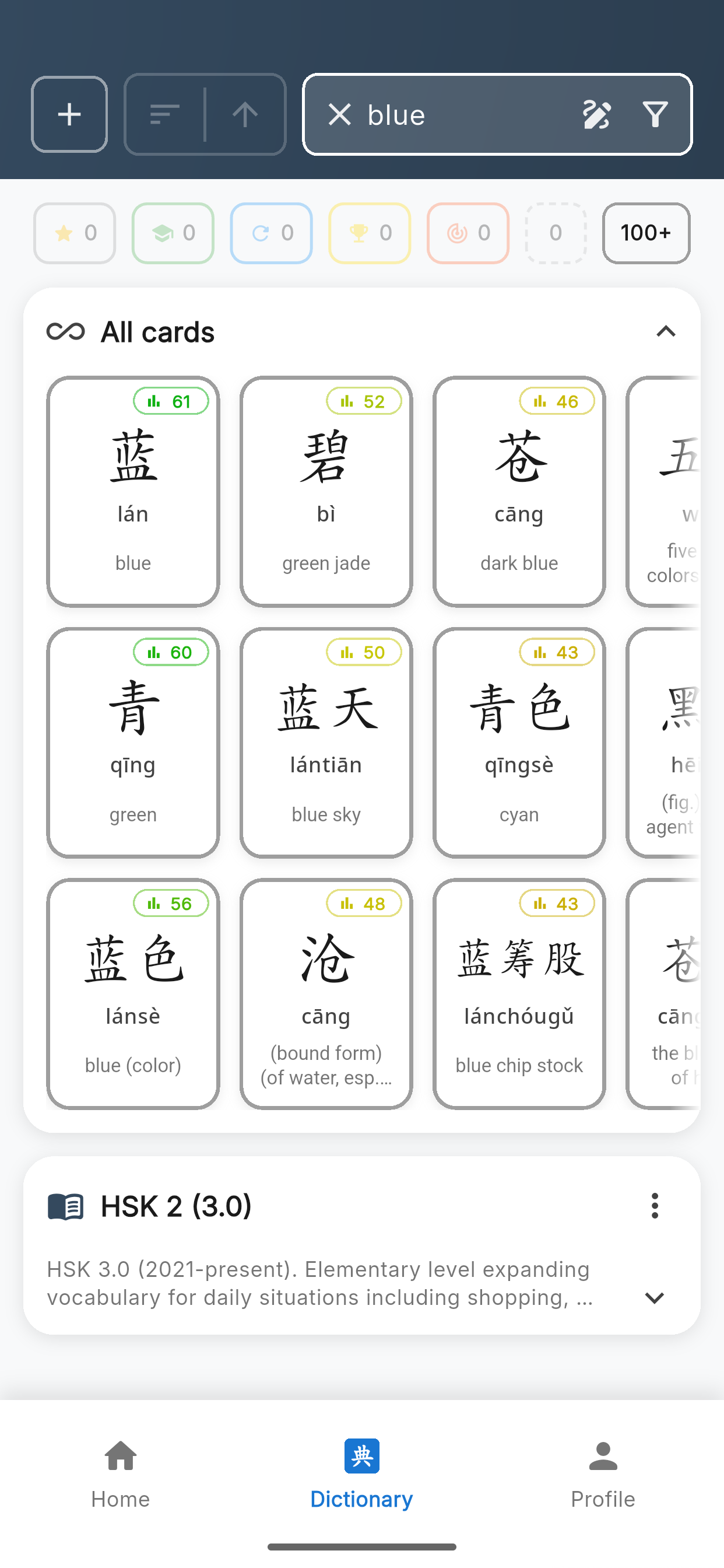
Hanzio tests you four ways per word — meaning, pinyin, writing, audio — so it sticks.
Grounded in available product and source data
Recognizing a Chinese character on a flashcard isn't the same as actually being able to write it, pronounce it, or pick it out by ear — Hanzio is built to learn Chinese characters with active recall specifically, testing each word four separate ways rather than treating recognition as mastery.
Those four modes — meaning, pinyin, writing, and audio — each get scheduled independently through spaced repetition, so a mode a user is weak on resurfaces more often while one they've already nailed stops eating into study time. A separate Practice phase exists just for the words that keep causing trouble, giving them focused attention instead of letting them drag down every regular review session.
The dictionary underneath all of this covers 150,000+ entries in both simplified and traditional characters, with stroke-order animations, example sentences, and frequency data that ranks a searched word's synonyms by how commonly each is actually used. Characters break down into a component tree too — a character splits into its radicals, and each radical shows what other characters and words it turns up in — which is a different way into memorization than a flat definition alone.
Someone switching from another app isn't forced to start at zero either: previously known words can be marked as already mastered to skip ahead. The site states the full dictionary plus 10 minutes of daily study is free with no limit on which words can be learned, and that Premium buys more daily study time without locking any specific word behind a paywall.
No — the site states its four-way testing (meaning, pinyin, writing, audio) means a user either produces the correct answer in each mode or doesn't, rather than self-grading recognition on a flashcard as mastery.
No — previously known words can be marked as mastered to skip ahead, which the site frames as specifically useful for someone switching over from another learning app rather than repeating material already known.
It explains the structure too — every character can be broken into a tree of its components, with each piece showing what other characters and words it appears in, alongside the option to add a personal mnemonic.
No — the site states Hanzio works offline and syncs across devices, which fits its stated design around short sessions like a commute or a few minutes before bed.
No — the site states the entire 150,000+ entry dictionary, including stroke order, character trees, and example sentences, is free alongside 10 minutes of daily study, with Premium only adding more study time per day, not gated words.


